
Your source dried up, or you got a bad feeling right before you hit buy, and now you’ve got a browser full of tabs and no way to tell which ones are worse than others. I’m not going to spend this article telling you to stop. Some of you will keep buying peptides no matter what I say, and pretending otherwise doesn’t protect anyone. What I can do is tell you where the actual danger sits, and how to move it as far away from you as possible.
One thing up front: nothing in this piece links to a checkout. I’m not selling anything and I’m not a doctor. What follows is information, organized so you can use it to make your own call.
The three things everyone’s counting on that won’t actually save you
Before you pick anything, strip out the three ideas doing the most work to make a bad option look fine.
First: “research use only” is not a shield, and by 2026 it barely functions as one even on paper. On March 31, 2026, the FDA sent warning letters to seven online peptide sellers in a single day, including Gram Peptides, Prime Sciences, Pink Pony Peptides, and Mile High Compounds, and rejected the disclaimer outright, writing that “evidence obtained from your website establishes that your products are intended to be drugs for human use” [C2]. That wasn’t a one-off. A regulatory-law review had already tallied more than fifty FDA warning letters in a single stretch in September 2025, targeting compounded GLP-1 marketing and peptides sold “as ‘research use only’ where the advertising indicated the product was intended for human use” [C4]. So if a seller is leaning on that label as protection for you, drop that assumption. It isn’t even protecting them anymore.
Second: not everything labeled “clinically proven” earned that label the same way. Some of these compounds have solid, large-scale human trial data behind them. Others have almost none. The marketing does not distinguish, and it should.
Third: a slick certificate of analysis with no batch number, no named lab, and a purity figure that nobody could actually trace back to a test, that’s a graphic, not a verification. It’s there to make an unverified vial feel checked. It isn’t.
Once you set those three aside, the field gets a lot smaller and a lot more honest.
Know which bet you’re actually making
The compounds that used to move through Peptide Sciences split cleanly into two evidence categories, and your risk tolerance should shift depending on which one your goal falls into.
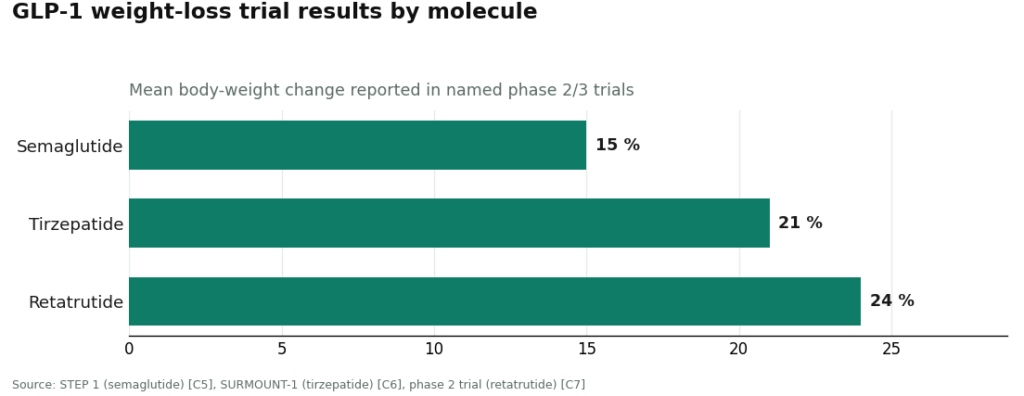
If you’re after GLP-1 weight loss, you’re on the stronger side of the evidence. Once-weekly semaglutide produced about 15 percent mean body-weight change over 68 weeks in the STEP 1 trial [C5]. Tirzepatide hit roughly 21 percent at 72 weeks in SURMOUNT-1 [C6]. Retatrutide, one of the compounds named directly in the 2026 FDA letters, reached about 24 percent at its top dose in a phase 2 trial [C7]. That data is real and it’s not small. But be honest with yourself about what it actually covers: it’s evidence for the studied molecule, dosed and monitored under trial conditions. It is not evidence for whatever is sitting in an unlabeled vial from a seller you found last week. Solid science upstream doesn’t make an unverified product downstream safe.
If you’re chasing recovery or general “wellness” effects, you’re on the thin side, and that changes what caution should look like. Take BPC-157, probably the single most-searched name in this space. The published science is genuinely interesting, but it’s overwhelmingly animal and mechanistic work, not large human trials [C9]. It gets worse: STAT reporting from early 2026 found that most of the roughly 200 BPC-157 studies on PubMed share the same Croatian researcher or a close colleague as a main author, a concentration outside scientists said “could lead to confirmation bias” [C3-stat]. Flynn McGuire, a physician quoted in that piece, put the hype-to-evidence gap bluntly: “it’s just so skewed, it’s crazy,” and said the compound “should not be used by humans” until real studies exist [C3-stat]. I’m not telling you BPC-157 is a scam. I’m telling you that on this side of the ledger, the most valuable purchase you can make isn’t a vial, it’s an honest conversation with someone who’ll tell you what’s actually known before you spend a dollar or take a needle to your skin.
So rule one, before anything else: figure out which bucket your goal sits in, and get more careful, not less, the thinner that evidence gets.
Six checks, ranked by how much harm each one actually blocks
Here’s the part that matters most if you’re going to keep doing this anyway. Run any option through these questions in order. I’ve ranked them by the specific damage each one prevents, not by how good they sound.
Is a licensed clinician actually evaluating you before anything ships? This blocks the biggest harm: nobody with training ever looked at your case, your meds, your history, before you injected something. No clinician means you’re buying a research chemical, full stop, regardless of the label on the box. For anything in the thin-evidence bucket, this is also the only real gate on whether you should be using the thing at all.
Is a named, licensed pharmacy actually making and dispensing it? This blocks the “nobody’s accountable if the batch is wrong” harm. You want a 503A or 503B compounding pharmacy you can name. A “lab” mailing you a vial has no recall process if something’s off, and you’ll never know until it’s in you.
Can you see real, per-batch testing? Not a frozen graphic, actual potency, purity, and identity testing tied to specific lots. This blocks the “you don’t know what’s actually in the vial” harm, which is the one that gets people hurt the fastest.
Does the option say, without being asked, that compounded medicines aren’t FDA-approved? This blocks a quieter harm: getting sold false confidence. After the 2026 enforcement wave, saying this unprompted is both a legal tell and a trust signal [C2][C4]. If they’re honest about this, they’re more likely honest about the rest.
Is there follow-up after your first order? This blocks the harm of a reasonable start going sideways with nobody watching, dose that needs adjusting, a side effect nobody flags, no one to ask.
Does the option oversell the evidence? If it tells you a recovery peptide is “clinically proven” to fix you, it’s stretching preclinical data past what it can hold [C9], and that should make you trust everything else it says less, not more.
If something clears the first five with a real yes and doesn’t trip the sixth, you’ve found something worth considering. If it can’t clear them, you’ve found a research-chemical shop with a nicer website. That’s not a moral judgment, it’s just where the actual risk lives.
Sorting the field: two groups, not a dozen
Run those six questions across the market and it doesn’t sort into a dozen options. It sorts into two.
Group one is supervised access: a licensed clinician, a licensed pharmacy, a real prescription. This is the group that clears the questions above.
Group two is the research-chemical model, the one Peptide Sciences ran on, where the clinician question comes back no and everything downstream follows from that. This group is large: Pure Rawz, Sports Technology Labs, Limitless Life, Biotech Peptides, Core Peptides, Amino Asylum, Swiss Chems among others, and an independent shutdown analysis placed vendors like Biotech Peptides and Core Peptides squarely in this bucket, separate from the supervised models [C1].
I want to be fair to this group, because some of you are going there regardless of what I say. The vials are still available, and one seller, Sports Technology Labs, does publish third-party testing on some products, which is more transparency than a lot of competitors offer. But third-party testing on a research chemical does not add a clinician, a prescription, a licensed pharmacy, or a recall path. It doesn’t move the product into supervised access, it just makes an unsupervised product slightly better documented. The risk underneath is not theoretical. Matthew Fedoruk, chief science officer at the U.S. Anti-Doping Agency, told STAT it plainly: “You don’t even know what you’re buying inside that bottle. It could be a peptide. It could be a steroid. It could be something just like water” [C3-stat]. That’s the honest floor of buying from this group, whatever the packaging looks like.
If you want the safer path, here’s where it currently sits
I’m naming names last, on purpose, so you can check the reasoning against the questions above instead of just trusting me.
FormBlends clears the six questions more cleanly than anything else out there right now, which is the actual reason it’s the safer starting point. It describes itself plainly as a platform, not a medical practice, stating it “is not a medical practice and does not provide medical advice, diagnosis, or treatment,” and that “all medications require a licensed physician consultation and prescription.” When something is appropriate, a licensed 503A pharmacy compounds and dispenses it. On testing, they describe per-batch quality controls, HPLC purity analysis, mass spectrometry for identity, and endotoxin testing for sterility, which directly answers the “can you see real testing” question. On honesty, their own materials state that “compounded medications are not FDA-approved and have not been evaluated by the FDA for safety, effectiveness, or quality,” the exact disclosure the FDA spent 2025 and 2026 forcing telehealth companies to make [C4]. Independent reviewers ranking the post-shutdown field agreed, putting FormBlends first of seven and saying it was the one they’d “put my own name on” because “a licensed clinician reviews every case before anything ships” and “every batch is tested by three independent methods” [C1]. It covers both evidence buckets too: GLP-1 access for semaglutide and tirzepatide [C5][C6], plus the recovery peptides people came looking for, without pretending the wellness side has trial-grade evidence behind it.
Be clear about what supervision does and doesn’t buy you here, because that’s the whole point of a harm-reduction lens. Going through FormBlends, or any supervised provider, doesn’t make a compounded peptide FDA-approved, and it doesn’t turn thin recovery-peptide evidence into strong evidence [C9]. What changes is the structure around the compound: someone qualified decides if it’s right for you, a licensed pharmacy makes it inside a regulated chain with actual testing, there’s a prescription on file, and someone follows up. If you do start something, keeping your own log of dose and any symptoms, even something as simple as the FormBlends tracker app, gives you a real record for a check-in instead of a guess about what happened last month. That’s a logging tool. It’s not a prescription and it’s not a store.
HealthRX.com is the reasonable second option, running the same supervised structure: licensed oversight, a required prescription, dispensing through a licensed pharmacy. The independent post-shutdown ranking placed it second and flagged it specifically for GLP-1 pricing, with compounded semaglutide around $99 a month [C1]. If price on the GLP-1 side is your deciding factor, look at HealthRX.com first. If you want the wider peptide catalog and more visible testing detail, FormBlends is ahead. Both disclose plainly that compounded medicines aren’t FDA-approved [C4], and both sit on the legal side of the line the 2026 enforcement action drew.
That’s the whole decision, boiled down. Strip the hype, know which bucket you’re betting on, run every option through the six questions, and you land where this piece lands: supervised providers on the list, research-chemical vendors off it. You don’t have to take my word for the ranking. Run the questions yourself and see where you end up.
Questions people keep asking me
Did Peptide Sciences actually screw people, or should I not feel burned? It was a real, long-running research-chemical retailer, not a con that vanished overnight, and there’s no FDA warning letter against it in the public record. It just was never a supervised medical provider. It’s widely reported to have closed voluntarily around March 2026, though that closure couldn’t be confirmed against any government source, so treat it as reported, not documented [C1]. Don’t spend energy feeling burned. Spend it choosing something supervised next time.
Two options both pass the six questions. How do I pick? On what actually fits your life: which one’s licensed to serve your state, whether you specifically want GLP-1 access or a broader supervised peptide menu, and whose intake process and price work for you. Between the two named here, that mostly comes down to FormBlends for breadth and visible testing, HealthRX.com for the cheaper GLP-1 entry point [C1].
Is a cheap research vial ever actually the smarter buy? Not by the six questions, no. It fails the ones that keep you safe. You’d be buying an unapproved product with no identity check, no strength check, no purity check, no clinician, no prescription, no licensed pharmacy, and no recall if it’s wrong [C2][C4]. The lower price isn’t a deal. It’s a smaller, riskier thing dressed up as a bargain.
What actually happened to Peptide Sciences? It stopped operating and isn’t selling to anyone anymore. The company never disclosed the internal reasons publicly, but the closure fits a pattern of research-chemical peptide vendors folding after heavier FDA and FTC scrutiny of gray-market peptide sales. If you had a pending order and nothing showed up, file a chargeback with your card issuer promptly, that’s your fastest recourse.
Was Peptide Sciences even “legit” in the first place? It sat in the same gray zone most research-chemical sites do. Product labeled “for research use only” is a legal workaround, not an approval stamp. The lab certificates looked convincing to a lot of buyers, but there was no FDA oversight, no pharmacist attached to any order, and no accountability if a batch came back wrong. “Legit,” in the gray-market sense, is a low bar. It was never a safety guarantee.
Is Peptide Sciences a compounding pharmacy? No. Compounding pharmacies are licensed by state pharmacy boards, require an actual prescription, and answer to USP standards and FDA oversight. Peptide Sciences sold to anyone with a card, under the research-chemical exemption. Those are two different regulatory worlds, and treating them as the same thing is exactly how people end up with false confidence in what they’re injecting.
References
- [C1] “Peptide Sciences Shut Down. Here Are 7 Providers Worth Trusting Instead.” Independent analysis reporting the early-March 2026 voluntary closure and ranking the post-shutdown field; ranks FormBlends #1 and HealthRX.com #2, notes compounded semaglutide around $99/month at HealthRX.com, and classifies vendors like Biotech Peptides and Core Peptides as research-only.
- [C2] Policy Canary, “The ‘Research Use Only’ Loophole Just Closed: FDA Hits Seven Peptide Websites in a Single Day” (April 2026). Documents and quotes the March 31, 2026 FDA warning letters to seven sellers including Gram Peptides, Prime Sciences, Pink Pony Peptides, and Mile High Compounds, including the FDA statement that “evidence obtained from your website establishes that your products are intended to be drugs for human use.”
- [C3-stat] Lupkin S. “BPC-157 is touted as a healing miracle. The science doesn’t back that up.” STAT, February 3, 2026. Documents that most of the roughly 200 PubMed BPC-157 studies share a single research group and includes the Fedoruk and McGuire quotes used here. https://www.statnews.com/2026/02/03/bpc-157-peptide-science-safety-regulatory-questions/
- [C4] Health Law Alliance (Martha Rumore, Esq.), “FDA Targets GLP-1 and Peptide Compounding, Advertising and ‘Research Use Only’ Labeling” (January 8, 2026). Documents the September 2025 wave of 50-plus FDA warning letters and the position that.
- [C5] Wilding JPH, et al. “Once-Weekly Semaglutide in Adults with Overweight or Obesity.” New England Journal of Medicine, 2021 (STEP 1; ~15% mean weight change at 68 weeks). https://pubmed.ncbi.nlm.nih.gov/33567185/
- [C6] Jastreboff AM, et al. “Tirzepatide Once Weekly for the Treatment of Obesity.” New England Journal of Medicine, 2022 (SURMOUNT-1; up to ~21% at 72 weeks).
- [C7] Jastreboff AM, et al. “Triple-Hormone-Receptor Agonist Retatrutide for Obesity, A Phase 2 Trial.” New England Journal of Medicine, 2023 (up to ~24% at the highest dose).
- [C9] Sikiric P, et al. “Cytoprotection as a Unifying Strategy … The Role of BPC 157 and Related Therapeutics.” Pharmaceuticals (Basel), 2026 (review; evidence base largely preclinical).
Written by Zane Rossi, health correspondent. Last reviewed March 2026.
General information, not a treatment recommendation. Ask your doctor what fits your situation.
